
Imagine your mission finally helping to fund itself.
You have spent years helping your community with less money, thinner margins, and more demands on the same small team. Now imagine that one of the things you already want to do—help local people find useful work—also creates a modest, recurring source of revenue for the organization doing the coordinating.
Six years in, the mission is still good. The math is getting worse.
Imagine you run a small nonprofit. You started because you wanted to make something better—not because you wanted to spend your life chasing grants, stretching payroll, writing donor appeals, and deciding which useful thing the organization cannot afford this year.
The community still needs you. Your staff deserves better pay. Funders increasingly want evidence of participation and measurable outcomes. But every year seems to ask the organization to accomplish more with less.
What if the first new asset you built wasn't a building or a funding campaign—but a stronger local economy?
She doesn't need another inspirational slogan. She needs a different mechanism.
Imagine the moment when the question changes from “Who might fund us?” to “What useful activity is already possible here?”
There are people who need work. People who need help. Skills sitting idle. Household-scale businesses that could grow. Relationships that already exist. None of those things are cash, but all of them are capital.
The first move is not to ask the community for more money. It is to help the community make more money.
Picture the organization a year from now.
People in the community are finding work through a network they trust. Local households are hiring one another. Your staff can see what people need, where skills exist, and which relationships are becoming productive. A small share of the economic activity helps support the nonprofit that made the network possible.
Launch a simple Hire & Help Local initiative. Ask the community what work people can do, what help households need, and who wants to participate. The outreach itself reconnects the organization to people it may not have heard from in years.
Bring participants into a bounded Commonweave community. Real people establish identities, local participation has context, and reputation is earned through behavior—not purchased through advertising.
A retired bookkeeper helps a local business. A neighbor repairs a fence. Someone provides transportation. A teenager gets weekend work. A household hires a cleaner. Useful transactions begin happening among people who are actually part of the community.
If your organization chooses to retain a community transaction fee, each successful exchange can contribute a small amount toward operating the network. Individually the amounts are modest. Repeated across hundreds of useful local transactions, they begin to matter.
Instead of telling a prospective funder only what you hope to accomplish, you can point to participation, local economic activity, recurring relationships, and the operating capacity your organization has already built. That does not guarantee funding—but it gives the story substance.
Better staff capacity supports better outreach. Better outreach brings more useful participation. More participation creates more local exchange. The community can help decide how locally retained value should be reinvested.
Help wanted. From actual people in your community.
Reach is useful until reach destroys context. A local work network does not need thousands of anonymous applicants. It needs enough real people, in the right place, who can establish trust with one another.
Help wanted. From actual people in your community.
A few decades ago, “help wanted” usually meant something wonderfully simple: somebody nearby needed something done, and somebody else nearby could do it. Commonweave brings that local exchange into a modern, high-trust environment built around verified identity, community boundaries, reputation, and useful context.
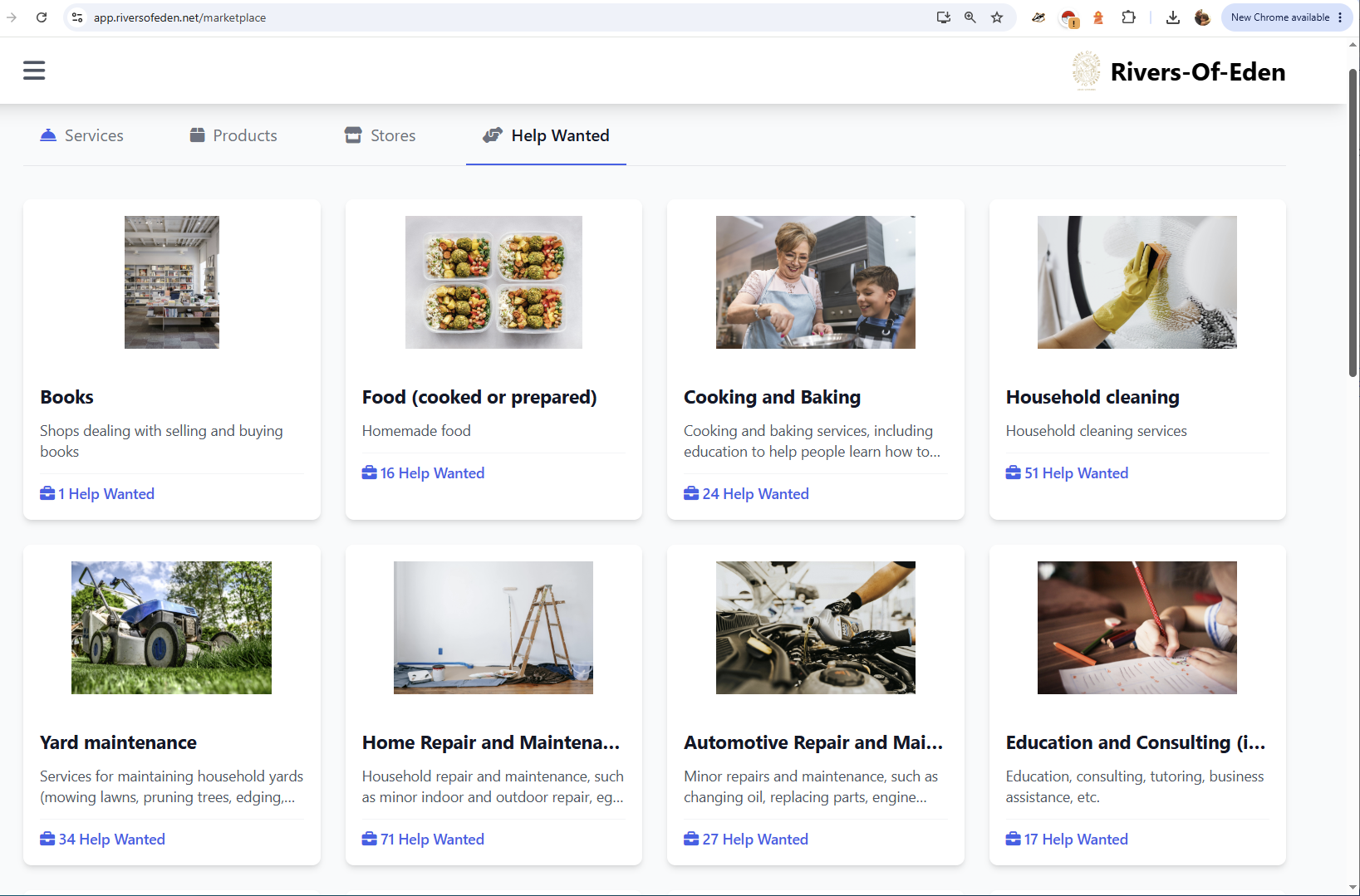
Start with work people already need done.
Yard maintenance. Household repair. Automotive help. Cooking. Cleaning. Tutoring. Small jobs that are often too local, too specific, or too human for a global employment platform.
Instead of optimizing for maximum reach, a community can optimize for relevance and trust.
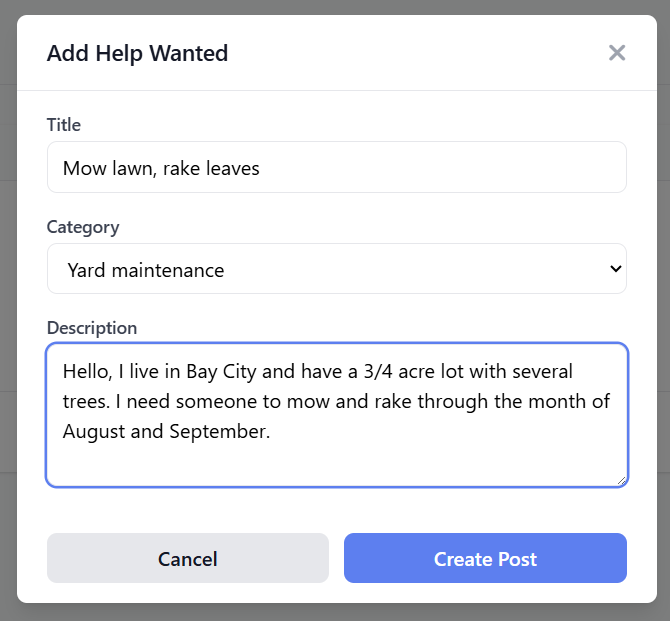
“I need somebody to mow and rake through September.”
That is enough. A member describes the work, chooses a category, and posts it into the bounded community.
The technology adds modern conveniences. The social logic remains old-fashioned: someone nearby needs help; someone nearby can help.
The internet gave us access to everybody. Commonweave gives a community the ability to know who is actually there.
The nonprofit is no longer only distributing help. It is coordinating capacity.
The staff begins to see the community differently. A person who arrived needing assistance may also have a skill someone else needs. A household business may become an employer. A volunteer may become a provider. The organization becomes better at seeing and connecting assets that were present all along.
That makes the nonprofit more useful to its community—and more legible to partners and funders looking for evidence that an organization can turn resources into durable local capacity.
The win is not that the nonprofit found another donor.
The win is that more people can help themselves, help one another, and help sustain the institution connecting them.
That is the economic loop Commonweave is designed to make visible and operable. The organization creates the conditions for useful exchange; the community creates the value; and some of that value can remain close to home.
What could a modest Hire & Help Local network do?
This is not a forecast. It is a sandbox. Move the sliders and ask what seems plausible for your own community.
Illustrative economic model only. These figures are hypothetical and are not a projection, promise, or guarantee of participation, transaction volume, revenue, funding, or financial performance. Actual results depend on community size, activation, pricing, participation, fee structure, local conditions, and execution.
Same infrastructure. Different community problem.
Commonweave is not a single use case. Each Imagine scenario starts with capacity that already exists and asks what becomes possible when a community can coordinate it.
Imagine what your community could do with it.
Tell us what your organization is trying to accomplish. We can start with the people, skills, relationships, and economic activity you already have—and model a plausible path from there.
Does this path look familiar?
Contact us and we'll start the conversation with this scenario already attached, so you don't have to explain which Commonweave use case brought you here.
Contact us about this path →Start with this path.
We already know you came here through the Imagine — Struggling Nonprofit scenario. Tell us enough to begin the conversation.